
Capturing the Impact of FutureNeuro: The Stories That Shaped 2025
2025 was an exciting year for FutureNeuro—one in which advances in diagnostics, therapeutics, and digital health were matched by deeper collaboration with clinicians, policymakers, patients, families, and the wider public. Strengthened partnerships across research, care, and industry helped move meaningful impact closer to people living with brain conditions. Throughout the year, our researchers progressed early-stage therapeutics, advanced diagnostic pathways using blood-based and wearable biomarkers and applied data science to uncover patterns in health data that can inform future care.
Building Capacity: Funding and Talent
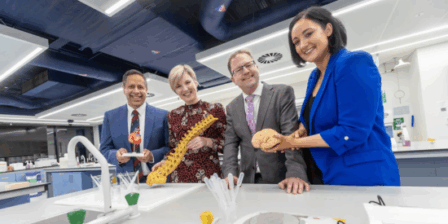
Progress requires both funding and expertise. On the funding front, FutureNeuro secured significant investment in 2025, most notably funding secured to ensure Ireland’s contribution to the €45 million Genome of Europe project. Co-led by Deputy Director Prof Gianpiero Cavalleri, the Genome of Ireland initiative will sequence 1,200 Irish genomes to build a national reference and improve rare disease diagnosis. This was complemented by multiple individual research grants, including Dr Jennifer Dowling’s €791,428 Research Ireland Frontiers for the Future award to advance a novel therapeutic strategy for epilepsy.
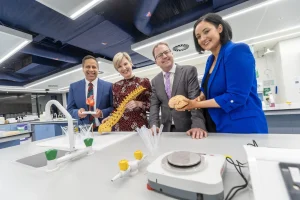
Alongside funding, the Centre strengthened its research capacity by welcoming new investigators Dr Malika Bendechache (University of Galway) and Dr Pat Moloney (UCD, Mater Hospital), who bring critical expertise in AI and clinical neurology to FutureNeuro’s expanding portfolio.
Just as important as recruiting established researchers is cultivating the next generation. Training programs across the Centre reached important milestones in 2025: the MSCA NeuroInsight COFUND graduated many of its Fellows, the NeuroAdapt COFUND welcomed its first, and the Centre for Research Training in Genomics Data Science, of which we are a partner, celebrated the graduation of its newest genomics researchers.
Industry Partnerships Drive Patient Impact
One of the year’s major developments was the Irish arm of a European multi-site clinical trial testing the EpiSight system—a small device placed under the skin that records brain activity continuously at home. Irish sites, led by Prof Norman Delanty at Beaumont Hospital and Dr Daniel Costello at Cork University Hospital, enrolled more than half of all participants. If successful, this approach could reduce diagnostic waiting times, and ease pressure on hospital resources.
This advance in monitoring was matched by progress in prevention. Prof Tobias Engel’s team, working in separate complementary studies with pharmaceutical partners Janssen and Affectis, built on their long-standing research on the protein receptor P2X7, advancing its potential as a target for preventing epilepsy after head trauma. Prof Engel and his team also developed an imaging tool that may help doctors predict who is at highest risk of developing seizures after brain injury, opening the door to early intervention before epilepsy develops.
Meanwhile, Dr Gary Brennan’s lab at UCD, collaborated with Chemestmed on RNA-modifying compounds with potential anticonvulsant effects, while FutureNeuro clinicians contributed to international studies on cannabidiol in rare genetic epilepsies and immunotherapy for drug-resistant cases.
Data-Driven Insights Transform Care Planning
Electronic health records contain a wealth of information, but that data is only valuable if it can be analysed ethically and used to improve care. This year, FutureNeuro demonstrated how patient data—when properly governed and anonymized—can transform healthcare planning. In a landmark study, Professors Colin Doherty and Norman Delanty analysed records from 5,720 people attending specialist epilepsy services, creating the first comprehensive map of epilepsy care needs across Ireland. The analysis revealed patterns in who accesses care, where gaps exist, and how resources might be better allocated—insights impossible to obtain from individual clinical encounters alone.
Building on this foundation, the LEGEND project—seed-funded with Novartis Ireland through the Research Ireland EMPOWER Data Governance Spoke—introduced the EpiData Dashboard, an interactive tool that allows clinicians and policymakers to explore anonymized patient data in real-time. Imagine a hospital administrator being able to see—at a glance—where wait times are longest, which treatments are most commonly prescribed, or how many patients might benefit from a new therapy. This prototype represents a significant step toward data-informed healthcare.
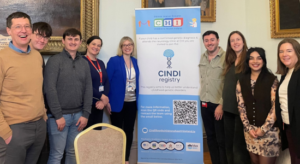
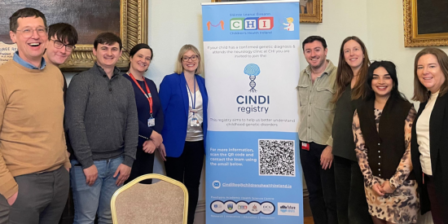
Patient registries highlight the impact of coordinated data. The Collaboration in Genomic Disorders in Ireland (CINDI) registry is a powerful example. Established in 2023 through seed funding and leadership from Children’s Health Ireland (CHI), in partnership with FutureNeuro, the registry—developed by our clinical researcher Dr Susan Byrne and clinical geneticist Dr Janna Kenny—has enrolled over 100 children and young people, helping to mainstream genomic research into routine clinical care and improve outcomes for children born in Ireland with diagnosed or suspected neurogenetic conditions. The results speak for themselves: 14 children have received precision therapies tailored to their genetic condition, five have been matched to clinical trials, and many more have undergone advanced testing, helping to shorten their families’ diagnostic journey—sometimes by years.
These data initiatives were supported by research into public trust. Work led by Prof Kathleen Bennett and Dr Tina Bedenik explored what Irish people expect regarding consent and governance in health data systems—crucial evidence as Ireland prepares for the European Health Data Space.
Therapeutic Discoveries Point to New Directions
Several discoveries this year revealed new aspects of how brain cells communicate—and how that communication goes wrong in disease. Prof Jochen Prehn’s group identified tRNA fragments—pieces of genetic material previously overlooked—that influence how neurons signal to each other across multiple conditions, including ALS. Finding shared molecular pathways across different neurological conditions suggests that a therapy developed for one disease might benefit others, highlighting the strength and value of the Centre’s collaborative model.
Dr Gary Brennan’s team discovered that a chemical modification to RNA (a process called methylation) is elevated in epilepsy and changes how neurons process energy. This matters because current epilepsy medications often come with significant side effects; targeting these RNA modifications might offer a way to prevent seizures while avoiding those complications.
In Rett syndrome research, Prof Daniela Tropea’s work showed that a key protein—MeCP2—doesn’t just regulate genes in the cell’s control centre, but also moves throughout the cell where it influences how neurons respond to inflammation. This finding opens new possibilities for therapeutic intervention.
Diagnostic Advances Support Precision Medicine
Better diagnosis means better treatment. This year brought advances in reading the body’s signals—from the gut to the spinal cord.
Prof Gianpiero Cavalleri contributed to the largest study to date of the gut microbiome in people with LGI1 autoimmune encephalitis, a rare brain inflammation condition. The research identified subtle microbial changes linked to genetic risk factors, strengthening evidence for gut-brain connections that might be therapeutically targeted.
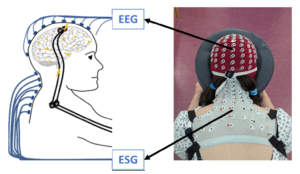
In neuromodulation research, Dr Bahman Nasseroleslami and Dr Prabhav Mehra developed SC10X/U—a standardized system for recording electrical signals from the spinal cord. Their system, initially validated in healthy volunteers, is now being applied to multiple sclerosis biomarker research, enables more reliable and reproducible data.
Dr Susan Byrne contributed to a Children’s Health Ireland-led study showing that genetic testing significantly improves diagnosis and treatment decisions in pediatric neurology—while also highlighting the resourcing needed to fully integrate genetic counselling into care pathways.
Understanding cannabis effects also advanced this year. Prof Mary Cannon and Prof David Cotter led research linking frequent cannabis use in young people to elevated levels of the inflammatory protein suPAR. The findings suggest a potential mechanism linking cannabis use, inflammation, and effects on brain development, and may inform future clinical trials exploring anti-inflammatory treatments for psychosis.
Putting Patients and Communities at the Centre
FutureNeuro’s commitment to engaged research deepened significantly in 2025, reaching more than 1,000 members of the public.
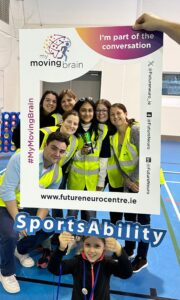
Community engagement reached new audiences across Cork, Maynooth, and Galway through our My Moving Brain Community Connect Series. These events created meaningful dialogue, fostered new relationships, and are informing the programme’s national legacy outputs for 2026. FutureNeuro was particularly grateful for the support of Prof Lorna Lopez and her team at Maynooth University, whose collaboration strengthened the impact of the series. Further reach came through the MyHealth RCSI podcast episode “Movement for Healthy Brains,” which brought together researchers and community voices to explore the role of physical activity in brain health.

New patient and public involvement (PPI) panels formed throughout the year, including one focused on post-traumatic epilepsy, bringing the total to 14 panels actively shaping research priorities. Fellows in the NeuroAdapt program participated in a PPI Dragons’ Den event, where they received feedback from people with lived experience—ensuring their research stays grounded in real-world needs.
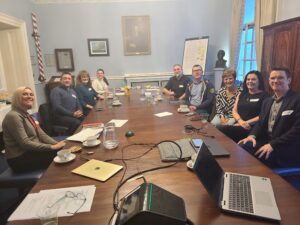
Educational and creative initiatives expanded this year. The Seizures and Me workshop provided a supportive space for young people to explore their experiences of seizures, while Cell Explorers brought hands-on neuroscience into classrooms across Ireland. Dr Chris Greene shared his research on CNS barriers, brain health, and concussion with teachers across Ireland through CÚRAM’s Teachers in Residence Programme.
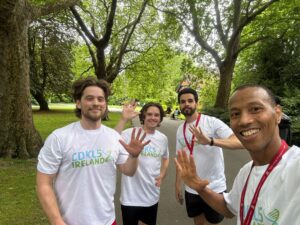
Partnerships with advocacy organizations strengthened throughout the year. The #5KforCDKL5 campaign led by Dr Omar Mamad and his team raised awareness for families affected by this rare condition, while the Epilepsy Research Matters event, co-led with Epilepsy Ireland, during Brain Awareness Week brought researchers and the epilepsy community together to share priorities and insights.
Shaping Policy and Practice
Beyond the laboratory, FutureNeuro scientists and clinicians contributed to national and international discussions on integrating genomics into healthcare, the neurological impacts of climate change, data protection in health research, and concussion and player welfare in sport.
Under Prof Orla Hardiman’s leadership, FutureNeuro played a key role in shaping a new Level 9 Postgraduate Diploma in Neurology Nursing, developed with RCSI and the HSE National Clinical Programme. The program addresses a critical workforce need as neurological conditions become more prevalent and treatments more complex.
Looking Ahead to 2026
The momentum of 2025 continues into the new year. FutureNeuro’s Clinical Conference on AI in Neurology will bring together clinicians, researchers, and industry partners to explore how emerging technologies can improve care. Our researchers will continue to compete for national and international funding while strengthening industry partnerships to enable new collaborative studies across multiple disease areas. Building on the success of our December PPI showcase, we will further embed engaged research into our studies. As Ireland prepares to host the EU Presidency, FutureNeuro looks forward to showcasing the societal and economic impact of our work to national and European audiences. Most importantly, the Centre remains committed to listening to and learning from the people whose experiences guide our research—because the future of brain health is built on partnership.

FutureNeuro extends our sincere thanks to Research Ireland, our industry partners, patient panels, advocacy groups, and our dedicated research and clinical community. Your support, expertise, and lived experience make this work possible.
Read More
Opening Doors: CINDI Registry Reaches 100 Families Milestone
FutureNeuro Investigator awarded Research Ireland Frontiers for the Future funding to explore novel therapeutic target in epilepsy
FutureNeuro Deputy Director Professor Gianpiero Cavalleri Co-Leads Ireland’s Contribution to the Genome of Europe Project