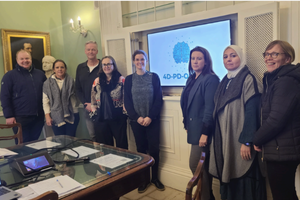

Spotlight on Dr Ziba Asadpoordezaki: Advancing Parkinson’s Research to Bridge the Care Gap
This World Parkinson’s Day, we’re proud to spotlight Dr Ziba Asadpoordezaki, a FutureNeuro Postdoctoral Researcher working to understand why certain neurons are particularly vulnerable in Parkinson’s disease — a question that could unlock earlier interventions and improve care.

This year’s theme, “Bridging the Care Gap,” underscores the urgent need for better support for people with Parkinson’s across Europe. Achieving this depends on research like Ziba’s, which is deepening our understanding of the disease and helping to shape more timely, targeted approaches to care.
From Stem Cells to Sleep: Tracing Parkinson’s Pathways
Ziba’s journey into Parkinson’s research began during her master’s studies in medical biotechnology, where she worked on stem cell therapy in multiple sclerosis. But her interest in neuroscience pulled her in a different direction.
“During my PhD at Maynooth University, I investigated sleep and circadian rhythm disruptions in Parkinson’s disease using a multidisciplinary approach… This work highlighted the importance of non-motor symptoms and their strong links to mood, cognition, and overall disease progression.”
Her early research revealed just how deeply sleep and circadian disruptions affect daily life for people with Parkinson’s.
“Sleep problems such as insomnia and excessive daytime sleepiness are strongly linked to cognitive decline, depression, OFF episodes, and reduced quality of life… Sleep and circadian dysfunction are a key and potentially modifiable aspect of Parkinson’s disease.”
Decoding Neuronal Vulnerability: The 4DPD-Omics Project
Now working under Prof Jochen Prehn, Ziba focuses on one of the most urgent questions in Parkinson’s research: why some brain cells are more vulnerable to degeneration than others.
“My research focuses on selective cellular vulnerability in Parkinson’s disease — understanding why certain dopaminergic neurons are more susceptible while others remain relatively resistant.”
Using advanced technologies including GeoMx spatial profiling and Cell DIVE, her work aims to pinpoint the molecular pathways that drive neurodegeneration.
“By combining animal models, human tissue samples, and cutting-edge spatial and single-cell technologies, we aim to identify the mechanisms that determine whether neurons are vulnerable or resilient.”
This research is essential for developing therapies that target the earliest changes in the brain, long before motor symptoms appear.
Bridging the Care Gap Through Research
Ziba sees scientific research as fundamental to improving Parkinson’s care, including closing the care gap highlighted this year.
“Bridging the care gap requires a shift from managing symptoms to developing strategies that can prevent or slow neurodegeneration.”
Her work in FutureNeuro directly contributes to this shift by enabling earlier identification of changes that precede significant neuronal loss.
“Projects like 4DPD help map these changes across human tissue and disease models, accelerating the discovery of more targeted and potentially disease-modifying therapies.”
She also highlights what Ireland needs to strengthen its national response to Parkinson’s:
“Expanding access to brain banking, supporting national research initiatives, and incorporating the lived experiences of people with Parkinson’s are all essential to ensure scientific advances translate into meaningful improvements in care.”
Looking Ahead
Despite the challenges, Ziba remains optimistic about the future of Parkinson’s research.
“With continued advances in understanding disease mechanisms, early detection, and targeted therapies, we will see meaningful progress.”
Her sense of purpose is clear:
“Our work directly impacts patients and their caregivers who are waiting for better solutions. This motivates me to approach research with integrity and dedication… with the hope of contributing to future therapeutic and preventive breakthroughs.”
World Parkinson’s Day reminds us that people living with Parkinson’s, and their families, deserve better support, clearer information, and access to care that evolves with their needs. Researchers like Dr Ziba Asadpoordezaki are helping make that future possible, advancing understanding, enabling earlier diagnosis, and driving progress toward more targeted treatments.