
FutureNeuro helps shape European discussions on the future of neurological health during Ireland’s EU Presidency
Ireland’s Presidency of the Council of the European Union comes at a pivotal moment for neurological health, with new EU initiatives on brain health, health data and research funding, including the next Framework Programme (FP10), the EU Biotech Act and the European Health Data Space, creating fresh opportunities to accelerate research and improve care across Europe.
FutureNeuro partnered with the Neurological Alliance of Ireland, the European Brain Council, the European Academy of Neurology, the European Federation of Neurological Associations and the Global Brain Health Institute to deliver Neurology at the Forefront of Innovation in Knowledge-Based Healthcare and Research Across Europe, held on World Brain Day at Europe House, Dublin, as an Associated Event of Ireland’s Presidency.
A defining moment for neurological health
Opening remarks came from Fearghas Ó Béara of the European Parliament Liaison Office and host Billy Kelleher MEP, followed by a keynote from Jennifer Carroll MacNeill TD, Minister for Health, and remarks from Kieran O’Donnell TD, Minister of State for Older People and Housing. Dr Gráinne Gorman, CEO of the Health Research Board, chaired proceedings.
Minister Carroll MacNeill set out the scale of the challenge: almost 860,000 people in Ireland, nearly one in six, live with a neurological condition, part of a European burden of over €300 billion a year. Speaking as Ireland opened its eighth Presidency, she said the goal was to bring innovation to patients at speed and to treat access as a matter of health equity across Europe. Minister O’Donnell pointed to a planned National Dementia Registry, targeted for 2028, and to emerging blood-based biomarker tests that could replace lumbar puncture in diagnosing Alzheimer’s. Billy Kelleher MEP called for EU-wide benchmarking, and a strategic focus as achieved through the Cardiovascular Strategy and Beating Cancer Plan, citing standardised neonatal testing as one area where Ireland lags EU peers.
An opening panel on healthcare systems — Professor Elena Moro, Dr Seán O’Dowd, Dr Orla Galvin, Eamon McPartlin, Professor Dominic Trépel, and Dr Eugene Wallace — stressed that patient-centred care depends on timely diagnosis and equitable access, noting that, across Europe, Ireland has the worst ratio of neurologists to patients. Dr Colm Henry, HSE Chief Clinical Officer, said the system needs to shift from reactive, hospital-centred care to a networked, community-enabled model, with a single shared healthcare record still missing.
Strengthening research and innovation
FutureNeuro led the event’s second panel, Strengthening Research and Innovation in Neurological Health, chaired by Dr Avril Kennan, CEO of Health Research Charities Ireland. Professor Gianpiero Cavalleri, Deputy Director of FutureNeuro, joined Frédéric Destrebecq (European Brain Council), Professor Susa Benseler (Children’s Health Ireland), Professor Iracema Leroi (Global Brain Health Institute) and John Nugent (IDA Ireland) to discuss how Ireland and Europe can turn scientific discovery into meaningful benefits for patients. Nuala Ryan, Chair of the NCBRS Worldwide Foundation and member of FutureNeuro’s Governance Committee, bringing the patient and family perspective.
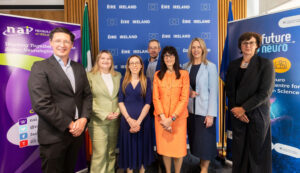
Professor Cavalleri pointed to Ireland’s strengths in translational neuroscience, genomics and digital health as a foundation for a future European Neurological Health Strategy. He noted that Ireland’s geography and size are a key enabler of research — reflected in its globally unique ALS registry — and pointed to Research Ireland’s dynamic funding model, which supports centres like FutureNeuro while encouraging collaboration with industry and European colleagues, as another major strength.
Professor Leroi set out how this applies to clinical trials, arguing that Ireland’s distinctive strength is coordination and quality rather than scale. Through the Wellcome–HRB Clinical Research Facility at St James’s Hospital and centres nationwide, Ireland already delivers complex Phase I–III brain-disorder trials to international standards.
The panel also called for a streamlined national study-start-up pathway, investment in specialist trial workforce, and more centralised ethics approval, noting GDPR and bureaucratic barriers still slow research even when patients want their data used.
Nuala Ryan urged policymakers to “put patients at the centre, not at the end.” John Nugent noted Ireland is home to 14 of the world’s top 15 medtech companies and 9 of the top 10 global pharmaceutical companies, underlining its potential to attract further investment.
Launching a Declaration for European action
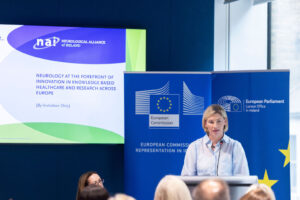
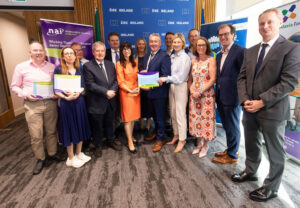
One of the day’s most significant moments was the launch of the Declaration on Advancing Neurological Health During Ireland’s EU Presidency, by Nina Carbery MEP, calling on Ireland to champion a coordinated European Neurological Health Strategy spanning prevention, diagnosis, treatment, rehabilitation, research and innovation. The event comes ahead of an own initiative report on neurological health that the European Parliament’s SANT Committee begins preparing this autumn, giving the Declaration a direct route into policymaking.
Looking ahead
For FutureNeuro, this event reinforced the value of working with patients, clinicians, policymakers, and international collaborators to accelerate research that improves lives. As Ireland’s Presidency continues, FutureNeuro looks forward to contributing to the growing European conversation around neurological health.