AI-EPOCMON: Bringing epilepsy medication monitoring closer to the patient
AI-EPOCMON, one of FutureNeuro’s strategic research programmes led by Dublin City University (DCU) is pairing printed sensors with artificial intelligence (AI) to rethink how epilepsy medication is monitored.
Imagine you live with epilepsy and, after months without one, you have a seizure. Your neurologist wants to know something simple: is the level of medication in your blood where it should be? To find out, blood is drawn and sent to a hospital laboratory. The answer arrives days later, often after your appointment is over.
That gap between the question and the answer is exactly what AI-EPOCMON sets out to close.
The people behind the research
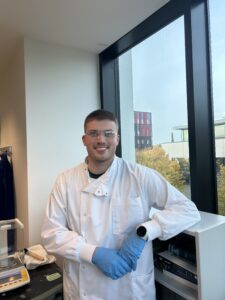
Dr Oisín Foley Doyle joined the project in August as a postdoctoral researcher in the Forster Research Group at DCU. His background is in electrochemistry, the science of how chemical reactions and electrical currents interact, with a focus on biosensing. On AI-EPOCMON, he leads the development of the sensor.
AI-EPOCMON stands for AI-enabled point-of-care monitoring. “Point-of-care” means the test happens wherever the patient is being seen, rather than in a distant lab. The programme is backed by a €1.6 million Research Ireland/NSF Centre-to-Centre award, with partners at Trinity College Dublin, Ulster University and Texas A&M University.
The goal, in Oisín’s words, is “a rapid, low-cost, point-of-care test that measures anti-seizure medication levels in the blood.” The first target is lamotrigine, one of the most widely prescribed anti-seizure medications.
Why medication levels matter so much
Medication levels can shift for many reasons: missed doses, interactions with other medicines, or changes in the body itself. Lamotrigine is a clear example. Its levels can fall substantially during pregnancy, or when someone starts an estrogen-containing contraceptive.
When a breakthrough seizure happens, “one of the first questions is whether their medication level is where it should be,” Oisín explains. A fast answer tells clinicians whether the dose needs adjusting, whether there’s a supportive conversation to have about taking doses as prescribed, or whether the level is fine and another explanation should be explored. While a drug level is only one part of the clinical picture, having it sooner could help clinicians make faster, better-informed decisions.
For patients, today’s system means extra trips to the hospital, time off work or school, and decisions made on out-of-date information. A result from a small blood sample in minutes would let the whole conversation happen in one visit. “The goal is for monitoring to fit around the patient’s life rather than the other way round.”
Ink, electricity and AI
At the heart of AI-EPOCMON is a small electrochemical sensor, which detects a chemical reaction and converts it into an electrical signal that can be measured. It is a screen-printed electrode: a small strip printed with conductive carbon ink, much as a design is printed onto a T-shirt. When a changing voltage is applied, lamotrigine reacts at the surface and produces a tiny electrical current. The shape of that signal reveals how much drug is present.
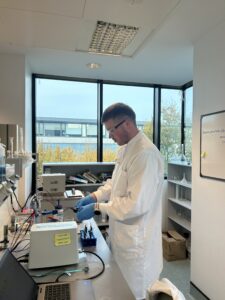
In a clean lab solution, reading that signal is fairly simple. Blood is another story. “Proteins, other medications and small differences between individual sensors all affect the signal,” says Oisín.
This is where AI earns its place. Rather than looking at a single peak, machine learning models learn from the full shape of the sensor’s response. They are trained on patient samples also measured by high-performance liquid chromatography (HPLC), a laboratory technique used to separate and measure chemical compounds. It is the reference method hospital labs use today. The models learn to separate the drug’s signal from the background and to correct for differences between sensors.
The challenges of low-cost testing
Many biosensors rely on antibodies or enzymes, biological molecules that latch onto a target. They work well, but they add cost, need careful storage and can have short shelf lives. The DCU team took a different route: aiming to detect lamotrigine directly on electrodes made with their own carbon inks, which are inexpensive to manufacture at scale and robust to store.
The trade-off is that blood is “a demanding environment.” Proteins can coat and clog the electrode, other compounds interfere, and printed strips vary from batch to batch. The team is responding on several fronts: refining the ink, adding catalytic coatings that amplify the drug’s signal, and using AI to absorb variability that would otherwise demand pricier hardware.
The early results are promising. The sensors have detected anti-seizure medication sensitively and reproducibly, at levels within and below the therapeutic range, the window where a drug works safely. For medicines that are harder to detect, modified electrode surfaces have boosted the signal, in some cases 100-fold.
No single institution could do this alone. DCU leads the sensor chemistry; Ulster University brings expertise in AI and intelligent systems; and Trinity College Dublin (TCD) leads clinical validation on patient samples. Together, Oisín says, they form “a genuinely end-to-end pipeline, from the chemistry of the electrode surface to a number a clinician can act on.”
Towards more personalised treatment
The next step is the big test: finalising the best sensor design and comparing it head-to-head with HPLC on real patient samples, in collaboration with TCD. Beyond that lie larger clinical studies, scaled-up manufacturing, simple finger-prick sampling and approval under the EU In Vitro Diagnostic Regulation. “None of this happens overnight,” Oisín says, “but robust validation data now is what makes those next steps possible.”
The ambition stretches further. Because the AI can untangle overlapping signals, a single test could one day measure several epilepsy medications at once. The same platform could also help with other medicines where the gap between an effective dose and a harmful one is narrow, such as lithium for bipolar disorder, certain antibiotics, and immunosuppressants after a transplant.
For FutureNeuro, projects like AI-EPOCMON are where research meets real-world impact. Working with partner universities, industry and funders, the centre aims to protect and develop promising discoveries so they can move from the lab bench to the clinic, and ultimately to the people who need them.
Think back to that patient waiting days for a result. Oisín pictures a very different future: “My hope is that within a decade, checking a medication level will be as routine and accessible as checking blood glucose.”