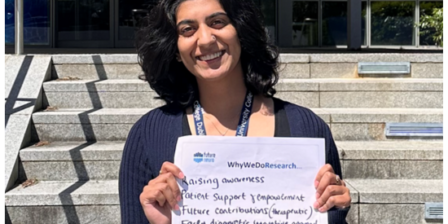

MSCA Fellow Dr Emily McLaughlin on bridging neuroscience and digital health innovation
As the Marie Skłodowska-Curie Actions (MSCA) marks its 30th anniversary, FutureNeuro is highlighting the experiences of early-career researchers supported through our MSCA programmes and their contribution to interdisciplinary, impact-driven research.
At FutureNeuro, researchers are increasingly exploring how digital technologies can improve our understanding of neurological conditions and support more personalised and effective care. For NeuroInsight Fellow Dr Emily McLaughlin, a recent placement on the DigiBio HealthTech Innovation Programme was an experience she describes as a turning point in how she approaches this challenge.

From psychology to digital neuroscience
Emily began her academic journey studying psychology at the University of Edinburgh before completing a PhD focused on how digital technologies could improve the way researchers measure change in people living with neurological conditions, particularly motor neurone disease.
Following postdoctoral research in Newcastle on digital tools for early dementia detection, she joined the PRECISION-ALS team led by Prof Orla Hardiman. Her current NeuroInsight Fellowship explores how speech data may provide insights into cognitive change over the course of motor neurone disease.
Clinical immersion and new perspectives on care
Emily says she was drawn to DigiBio because of its needs-led approach and focus on practical impact.
“I wanted the opportunity to build something myself that could have a real impact rather than being limited to a publication,” she says. “I also loved the opportunity to come in without a defined ‘idea’.”
A defining feature of the programme was clinical immersion, where fellows spent time in healthcare settings observing practice and identifying unmet needs.
“There really isn’t anything like the buzz of a hospital, with teams working together to solve problems,” Emily says. “We got to meet some great clinicians who took the time to teach us and explain the barriers that they face.”
The experience also highlighted the importance of multidisciplinary collaboration, bringing together researchers, engineers, clinicians, and designers with different perspectives on healthcare innovation.
“I was always approaching things from a research-focused angle of wanting to build the ‘best’ solution,” she explains. “What I’ve learned is that the solution also needs to be accessible and sustainable for patients in the real world.”
Rethinking Care Beyond the Clinic
Emily believes digital technologies could help researchers and clinicians better understand how neurological conditions affect people in everyday life, particularly outside traditional clinical settings.
“Working with people with motor neurone disease has always highlighted to me how much of a burden attending hospital can be,” she says. “If care and monitoring can happen at home, that should remain a priority.”
She also sees opportunities to move beyond checklist-style symptom tracking towards understanding how conditions affect the things that matter most to individuals.
Looking ahead
Emily says the DigiBio experience is already shaping the direction of her fellowship research, encouraging a stronger focus on how findings can translate into practical solutions.
She is also particularly excited by emerging research into sleep and brain health, an area she believes is beginning to receive the attention it deserves.
Her journey reflects the broader impact of MSCA and FutureNeuro: supporting researchers to combine scientific discovery with innovation and helping shape new approaches to understanding and managing neurological conditions.
You can find out more about FutureNeuro’s Digital Health Research Programme here.