
AI in Neurology: Advancing Clinical Care and Innovation in Ireland
From improving epilepsy diagnosis to accelerating rare disease research and empowering patients through digital tools, artificial intelligence (AI) is reshaping the future of neurological care. These themes were at the heart of FutureNeuro’s Clinical Conference, which brought together the all-Ireland neurology clinical network, leading Irish scientists and international experts to explore how AI can advance care and drive clinical innovation in Ireland.
Now in its sixth year, the conference provides a vital forum for clinicians and researchers to share knowledge, strengthen collaboration, and support the delivery of world-class clinical care and translational science. Clinical involvement remains central to FutureNeuro’s mission and impact.
Opening the conference, Prof Norman Delanty introduced key concepts — from machine learning and deep learning to large language models and natural language processing — while posing a question that framed many of the discussions that followed: how can AI move beyond generating data to delivering genuine impact for healthcare and society?
Enhancing Diagnosis Through AI
Several speakers highlighted AI’s growing role in supporting clinical decision-making.
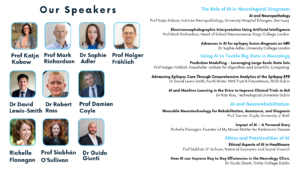
Prof Katja Kobow explored “Neuropathology 3.0”, describing the shift from traditional microscopy to fully digitised pathology that allows clinicians to zoom and navigate brain tissue images much like Google Maps. AI has particular promise in distinguishing between conditions that appear very similar under the microscope, such as Tuberous Sclerosis Complex and Focal Cortical Dysplasia. However, decades of specialist expertise shouldn’t be replaced just yet; the future lies in augmenting, not supplanting, clinical judgment.
Dr Sophie Adler addressed one of the most pressing challenges in epilepsy care: lesion detection. In a study of 1,000 MRI scans, experts detected only 55% of epilepsy-related structural abnormalities. Through the international Multi-centre Epilepsy Lesion Detection (MELD) project, Adler and colleagues developed a new graph-based AI model that significantly improves detection of subtle lesions associated with drug-resistant epilepsy. While the tools are open source, regulatory approval will be required before widespread clinical adoption.
Prof Mark Richardson highlighted similar challenges in EEG interpretation, where experts do not always agree, and false positives are common. He described a study drawing on 30,000 clinically annotated EEGs to develop AI systems that improve consistency and reduce error. Importantly, he emphasised the dangers of unbalanced data and over-reliance on automation.
Precision Medicine and the “Big Little Data” Problem
AI’s role in precision medicine was another key theme throughout the day. Prof Holger Fröhlich described the development of AI models that integrate longitudinal patient data, biomarkers, and multi-modal datasets. These approaches aim to better understand neurodegenerative diseases that often begin decades before symptoms appear.
Dr Robert Ross, working with Precision ALS, spoke about what he termed the “big little data problem” in rare diseases: rich, complex data for individual patients, but relatively small patient cohorts. Leveraging approaches such as temporal knowledge graph embedding and generative AI, his team is working to integrate fragmented datasets while managing expectations around timelines, privacy and regulatory constraints.
Dr David Lewis-Smith echoed the importance of real-world clinical data, describing Irish epilepsy records as “rich” and “multidimensional” despite gaps and inconsistencies. His work alongside a team of FutureNeuro researchers has led to the development of a dashboard that makes this longitudinal data more accessible to researchers.
Patients, Participation and Ethics
The human impact of AI in neurology was powerfully illustrated by Richelle Flanagan, who shared her experience of living with Parkinson’s disease. She highlighted the under-recognition of Parkinson’s disease in women and described her role in the development of a symptom-tracking app used by 2,000 people across 47 countries. While many patients are already turning to AI tools for advice, she stressed the need for clinical verification, describing AI as “a bridge, not a replacement” for clinical care.
Ethical governance was addressed by Prof Siobhán O’Sullivan, who urged the audience to think of AI not simply as a technology but as a capability. She highlighted issues of safety, bias, consent, transparency and trust, noting that large language models can “hallucinate” up to 10% of the time, a serious concern in healthcare settings. Real-world evaluation and strong governance, she argued, are essential if AI is to earn and maintain public trust.
As the conference demonstrated, AI holds enormous potential to improve neurological care, from diagnosis and prognosis to rehabilitation and patient empowerment. Realising that potential, however, will depend on careful governance, sustained clinical leadership and continued collaboration across research, healthcare and industry.
FutureNeuro gratefully acknowledges the support of the HRB, Jazz Pharma, Angelini Pharma, and IQVIA in enabling this important forum for clinical innovation.