
Families invited to take part in DS-TIME study exploring sleep disturbances in children with developmental syndromes
Researchers at FutureNeuro are inviting families to take part in the DS-TIME study, an ongoing research project aimed at improving understanding of sleep disturbances in children with developmental syndromes.
The study is led by FutureNeuro Funded Investigator Dr Cristina Reschke and Senior Postdoctoral Fellow Dr Radharani Benvenutti, in collaboration with colleagues at Children’s Health Ireland (CHI) and RCSI University of Medicine and Health Sciences.
Understanding Sleep Problems in Developmental Syndromes
Developmental syndromes are a group of neurogenetic conditions that begin in childhood and affect motor skills, cognition, and behaviour. These include conditions such as Dravet syndrome, Angelman syndrome, Rett syndrome, and CHD2-related developmental and epileptic encephalopathies.
Sleep difficulties are among the most commonly reported concerns for families affected by these conditions. Many caregivers describe severe and persistent sleep disturbances that impact not only the child, but the entire family. Despite how common these challenges are, the biological mechanisms underlying sleep problems in developmental syndromes remain poorly understood.
There is growing evidence that sleep disturbances are linked to disruptions in the circadian system, the body’s internal biological clock. However, it is still unclear how these disruptions arise in children with developmental syndromes, or why sleep problems are often so severe and resistant to treatment.
About the DS-TIME Study
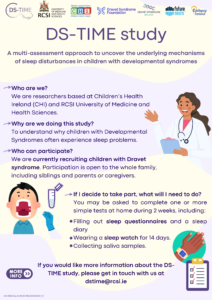
The DS-TIME study aims to characterise sleep and circadian patterns in children with developmental syndromes and to understand how these patterns impact family life.
The research team is currently recruiting children with Dravet syndrome, with participation open to the whole family, including siblings, parents, and caregivers.
Participation involves a two-week period of simple, at-home assessments, designed to minimise disruption to daily routines. These include:
- Completing sleep questionnaires and a sleep diary
- Wearing a non-invasive sleep (actigraphy) watch for 14 days
- Collecting saliva samples at home
By combining these measures, the study aims to build a detailed picture of sleep and circadian rhythms as they occur in everyday life.
Why this Research Matters
Findings from the DS-TIME study will help address a major gap in our understanding of sleep disorders in children with developmental syndromes and their wider impact on families. Importantly, this research will also provide a foundation for future work focused on earlier diagnosis and the development of more targeted strategies to reduce sleep disturbances and improve quality of life.
Get Involved
Families who would like to learn more about the DS-TIME study or are interested in taking part can contact the research team at dstime@rcsi.ie.